
June 4, 2025
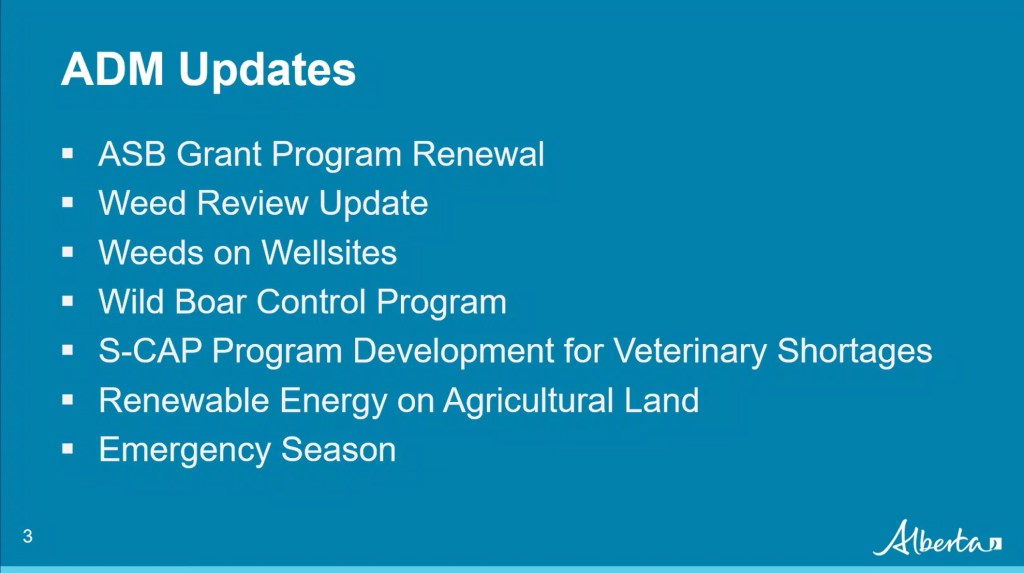
ASB Grant Program Renewal
The grant is considered pivotal by the Minister of Agriculture, who views the ASB program as central to sustaining the agricultural sector.
The program represents a renewed commitment to supporting municipal agricultural services, with ongoing discussions about potential future inflation adjustments or increasing the funding pool.
- 5-year agreement renewed for $66.4 million
- 90% of applications approved and in process
- 10-20% are executed and payments made
- Each municipality receives approximately $800,000 to $1 million
Weed Act Review Update
The Department remains committed to working “hand in glove” with the Weed Review Committee throughout the process of implementing any approved changes to weed regulations.
Currently ministry staff are finalizing documentation including recommendations for prohibited and noxious weed lists to take to the Minister for approval. This will be top priority for the Minister and his team when they return from their trade mission next week.
Communications to stakeholders including municipalities will happen through the Weed Review Committee and will likely include:
- Changes to prohibited noxious and noxious regulated weed lists
- Potential updates to supporting documents and resources
- Implementation guidance for approved changes
Weeds on Wellsites
ADM described efforts as “bringing some light” to the issue and has been involved in discussions with industry leaders. He sees the work as important for both municipalities and the agriculture industry as a whole. He is determined and optimistic that progress is being made and positive outcomes are coming.
The continued pressure and strategic engagement across government departments is key to a favorable outcome to address municipal concerns. While the concern is not yet fully resolved, they continue to pursue modifications to the tax rolls that aim to make the responsible parties pay for the weed control.
AGI staff are currently:
- Actively working to modify Municipal Government Act
- Aim to enable billing weed eradication costs to oil/gas companies
- Engaged with the Premier’s Mature Asset Strategy review
- Aim to have agriculture interests represented
- Continuing dialogue with Alberta Energy Regulator and Municipal Affairs
This work demonstrates the government’s commitment to proactive land management and addressing long-standing issues of weed control on abandoned or inactive well sites. It is important to shift the financial responsibility for weed control to the responsible parties. This work supports the broader effort to maintain agricultural land quality.
Wild Boar Control Program
The Government in consultation with key stakeholders is considering a systemic approach to eradication of wild boar in Alberta. This would mean transitioning wild boar from “livestock” to “pest” classification, and the goal would be eradication. There are currently 14 wild boar farms in Alberta.
To date, 539 Wild Boar at large have been eradicated. This year the province is planning to host wild boar tours that will teach participants how to identify wild boar presence, learn about habitat and behaviors, and train remote camera detection techniques. Anyone interested should reach out to Hannah McKenzie at 780-996-3373 or emailing wildboar@gov.ab.ca.
Key Timelines/Upcoming Actions:
- April-May 2024: Discussions with 14 wild boar producers
- Meetings with Alberta Pork and industry commissions
- June 17-18, 2024: Briefing Minister on recommendations
- Summer 2024: Hosting wild boar tours
Sustainable CAP for Veterinary Shortages
They are currently in final development stages for a Sustainable CAP program that is intended to support the complex challenges of veterinary recruitment and retention in rural Alberta. They are proposing $250,000 be allocated for a two year pilot program that aims to inform potential new options for addressing the veterinarian shortage. Rural mixed practices in remote locations are likely to have the highest priority in the program.
- $250,000 allocated for two-year pilot program
- Focus on recruitment and retention of veterinarians
- Emphasis on rural mixed practices and remote locations
- Exploring ways to make veterinary profession more attractive
Recognizing the need for a multi-tiered solution to the veterinary shortages, the topic is part of ongoing conversations with the federal and provincial partners preparing for the next 5 year agreement.
The ADM emphasized the program’s importance in addressing the complex challenges of veterinarian recruitment and retention in rural Alberta, including the mental and physical demands of the profession.
Renewable Energy Projects on Agriculture Land
New regulation prevents renewable projects on Class 1 and 2 agricultural lands unless it can be demonstrated that 80% of the agriculture use can be maintained. The same restrictions apply to Class 3 soils in municipalities that do not have Class 1 or 2 soils.
Currently Agriculture and Irrigation staff are working with staff from the Ministry of Affordability and Utilities and have input into the guidelines from the Alberta Utility Commission (AUC). The guidelines are intended to assist municipalities, landowners and developers conform to the regulation and assess and demonstrate the 80% agriculture use. These guidelines are expected to be published before the Calgary Stampede.
Strategic Objectives:
– Preserve arable land in face of climate change
– Create balanced approach to land use
– Protect Alberta’s agricultural production capabilities
The ADM emphasized this as a significant step in protecting agricultural lands while supporting renewable energy development.
Emergency Season Update
The dry spring and low snowpack have meant an early start to the wildfire season. Most areas of the province are below average snowpack and spring moisture. There are daily updates from the Provincial Emergency Coordination Centre, and they continue to monitor potential impacts in agricultural regions.
*Potential workforce strike may impact departmental efficiency. 90% of employees have voted for strike action, which will leave only managers working.
Conrad’s staff are feeding agriculture considerations into the emergency decision making process through close communication with the Intensive Livestock Working Group, Team Alberta Crops, and the Feather Boards.
Outlook is concern for the potential drought conditions but optimistic that June and July conditions may still improve. There are limited tools available for response to drought, with their primary strategy being “robust communication”.
Conrad emphasized a proactive, communicative approach to managing the emergency season’s agricultural impacts, and expressed solidarity with municipalities experiencing evacuations due to the challenging fire season.
Q&A
Question: How can we address the shortage of large animal and poultry veterinarians?
Response:
- Acknowledged challenges in veterinary specialization
- Committed to exploring pathways for large animal and poultry veterinary focus
- Recognized need for more targeted recruitment strategies
Question: When was the agricultural land classification system last updated?
Response:
- Confirmed last update was in 1995 (30 years ago)
- Acknowledged significant gap in land classification
- Recognized need for new study given agricultural and renewable energy changes
Question: Will battery storage (BESS) be subject to the same renewable energy land use regulations?
Response:
- Preliminary indication of exclusion from current regulations
- Ministry of Affordability and Utilities to provide additional information
- Ongoing investigation into regulatory framework
Further response received June 24:
- EELUVAR land impact assessments do not apply to battery storage facilities – they only apply to wind and solar power plants.
- EELUVAR irrigability assessment provisions apply to all power plants, but the Hydro and Electric Energy Act sets out energy storage facilities as separate from power plants.
- AUC’s interim information requirements released following EELUVAR are vague, but AUC has since clarified that storage will not be subject to coexistence requirements with agriculture in new final Rule 007.
- Guidance document is being developed by AGI and is expected by early July. It will be shared once available
Question: What is the current status of grasshopper populations?
Response:
- 3-4 instar grasshoppers emerging
- Detected in South Peace, Lamont/Minburn/St Paul, and southern border
- Noted early emergence compared to typical patterns
Question: How can the ASB grant application process be improved?
Response:
- Provost municipality raised complexity concerns
- ADM acknowledged need for process refinement
- Committed to learning from current cycle for future improvements
The discussion demonstrated a collaborative approach to addressing stakeholder concerns across agricultural sectors.
*Potential workforce strike may impact departmental efficiency. 90% of employees have voted for strike action, which will leave only managers working.
Discover more from Agricultural Service Boards
Subscribe to get the latest posts sent to your email.

You must be logged in to post a comment.