
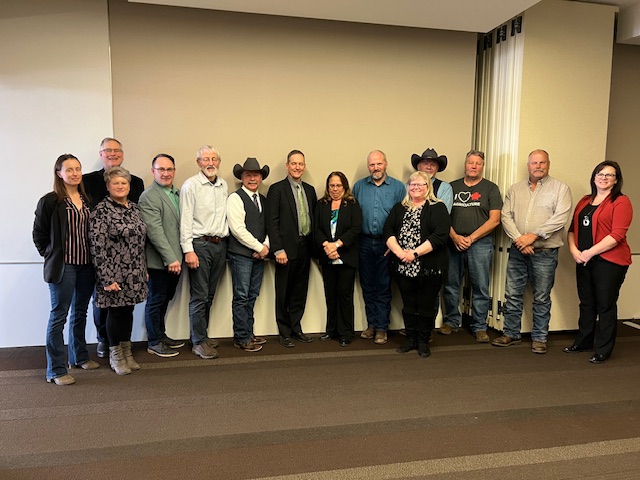
On March 17, 2025, the ASB Provincial Committee met in person and hosted several delegations including the Deputy Minster (DM) Jason Hale, and Assistant Deputy Minister (ADM) John Conrad.
The Committee touched on a number of topics stemming from the active resolutions as well as current events. Here are a few highlights.
Main Concerns with Creating a Permanent Ag Plastics Recycling Program
The Committee members noted that ag plastics recycling requires permanent, sustainable approaches rather than temporary initiatives. The current reliance on pilot programs creates uncertainty about future recycling options and works against adoption of the practice.
Funding emerged as a significant barrier to establishing permanent recycling infrastructure. The meetings highlighted that:
- Municipalities were bearing significant costs for recycling programs
- There was uncertainty about who should ultimately fund these programs—producers, manufacturers, or government
- The economic viability of recycling certain agricultural plastics was questionable without subsidies
The lack of a comprehensive regulatory framework was identified as a major obstacle. Emphasis was placed on the importance of having a framework for waste management that addresses different types of plastics and their disposal methods. Without this framework, coordinated provincial action will continue to be difficult to implement.
Several practical challenges were discussed:
- Transportation costs for bulky items like grain bags from farms to recycling facilities
- The difficulty of cleaning plastics contaminated with soil or organic matter
- Storage requirements on farms until collection
Coordination between different initiatives and organizations remains problematic. There was discussion about the need for better alignment between the provinces and municipal management systems. Other potential solutions to managing agriculture waste were discussed including the “waste to energy” pilot in the Peace, and new biodegradable alternatives to netwrap currently on the market.
The discussions reflected a complex challenge requiring coordination between multiple stakeholders, sustainable funding models, and potentially new technological approaches to create an effective permanent solution for agricultural plastics recycling in Alberta.
Concern for Tariffs on Agriculture Products
Committee members expressed serious concerns about tariffs, including direct financial strain on producers, disruption of established export markets, inflationary pressure throughout the supply chain, and competitive disadvantage against subsidized US farmers.
To mitigate these challenges, several strategies were discussed:
- Diversifying export markets beyond the US, with Japan identified as an eager buyer of Canadian products;
- Redirecting revenue from agricultural import tariffs back into the sector;
- Coordinating advocacy through unified messaging to government officials;
- Leveraging research organizations like RDAR to develop innovative solutions; and
- Promoting domestic consumption through “Made in Alberta” initiatives.
The discussions emphasized both immediate advocacy needs and long-term structural solutions to build resilience. Participants noted that current trade tensions create an opportunity to educate urban Canadians about the inherent uncertainties agricultural producers regularly face, potentially building greater public trust in Canada’s agriculture and food system.
Municipalities are encouraged to reach out to their local MLAs and MPs to create greater awareness about the current China imposed tariffs and what farmers are facing, to encourage support for any support that might become necessary.
Last year Agriculture accounted for $9 Billion in trade to the US, compared with the $126 Billion from the Oil and Gas to the US, making Oil and Gas a bigger “Trump” card in any tariff negotiations.
Biosecurity, Depopulation, and Disease Management in Agriculture
Discussions highlighted significant biosecurity concerns affecting Canadian agriculture, particularly regarding avian influenza, bovine tuberculosis, and chronic wasting disease. Alberta faces increasing depopulation events, with Linda Hunt noting that Western Canada experiences more livestock depopulation than anywhere else in the country.
Participants emphasized the traumatic impact of depopulation on farmers and veterinarians, with limited mental health support available during these crises. AgKnow organized a briefing on the diseases of concern this spring with the chief provincial veterinarian’s office to prepare counselors to respond to depopulation events, though funding challenges threaten this initiative.
Biosecurity was identified as a critical concern during farm tours and agritourism activities like Open Farm Days. “How do you draw that line?” regarding visitor access, noting that poultry and hog operations strictly limit entry due to disease risks. With the increasing threat of diseases like African swine fever and foot-and-mouth disease, it is important to emphasize prevention, monitoring, and emergency response planning.
Progress on the Weeds on Wellsites Concerns
The Weeds on Wellsites Working Group is addressing the significant challenge of weed management on oil and gas sites across Alberta. Discussions highlighted how this issue extends beyond mere aesthetics to impact agricultural trade, farm income, and regional biosecurity.
Ministry staff is collaborating with Alberta Energy and Municipal Affairs through the Mature Asset Strategy initiative, using this as a “fast-moving train” to advance recommendations. While weeds weren’t the primary focus of the broader strategy, the working group successfully raised awareness about agricultural impacts among energy sector participants. On suggested strategy was for Municipal Affairs to make the necessary changes that would allow municipalities to add the costs associated with weed control to the tax roll.
A two-phase survey is being developed to gather critical data on costs, impacts, and current management practices. The Weeds On Wellsites Working Group plans to reconvene in fall 2025 after the Mature Asset Strategy report is released in April, with recommendations expected to be implemented throughout 2025.
This meeting was held on March 26, however the Mature Asset Strategy Report was delayed so was not discussed or shared.
Other topics discussed included:
- Water Act Review – concerns about inter basin transfers
- Richardson ground squirrel control – growing concern, need better products
- Coop extension funding and coordination
- Mental health support for farmers
- Renewable energy project development – preserving agriculture land
- Support for bee industry with CFIA
Discover more from Agricultural Service Boards
Subscribe to get the latest posts sent to your email.

You must be logged in to post a comment.